Friday, January 6, 2012

Gmail New Look Sucks

What will Google earn if I start using the new looks in Gmail. This is the second time Google intentionally forced me to try the new looks in Gmail. How??? After loging in bhammm.... came a pop up message urging me to try the new looks. From there the only option to go to my inbox was to accept the offer or F*** off temporarily or permanently from Gmail.
Yes, there is an option to postpone switching to the new look, which for strange reasons known only to Google doesn't work. I had to reluctantly click on the Continue to the New Look button to continue and was welcomed by a messed up inbox. To keep it less offensive, the new look sucks!


The new look templates could be intended as New Year gifts for gmail users. I tried few of the templates, liked none and had to switch back to the good simple old template.

To switch back to the old look, I clicked on Setting and choose the option Switch Back to Old Look. There Google again gave me two buttons Swicth Back to Old Temporarily and Cancel. 'Temporarily?' I got the feeling that Google is going to permanently force us all to use the new templates when it thinks the time is ripe.

If you've not got such a mail and desperately want to try the new looks, click on Setting, select Mail Settings and click on the one liner message Gmail's getting a new look soon, select Learn More. There you are.
Let me know if you find something enchanting in some of the new looks that I missed.

Wednesday, January 4, 2012

Deactivating Airtel Value Added Services

If Airtel were a thief, I would say "You've become so fat after stealing my money."


Alas!!! can't do anything of that sort with a company that love minting only money.

It's crappishly frustrating when you are charged for services that you don't ask for. Airtel value added services (jokes, cricket, caller tune, job tips, miss call alerts, etc.) are things that I never have subscribed for, nevertheless Airtel activated some of these on my mobile for more than once. No matter how much I plead I've never got refund for whatever Airtel charged me for the services I didn't subscribe.

Lately, Airtel seems to have blocked pre-paid subscribers from reaching customer care executives. Anyways, they have better things to do than listen to complaints from pre-paid subscribers about unknown charges. Calling Airtel 121 (customer support) from a prepaid SIM just takes you to endless recorded IVRs (interactive voice response) to make your choices. We are not yet in that era where IVRs can fix problems that need human attention.

Well, if Airtel has activated something that you didn't ask for the best option is to deactivate the service yourself without calling 121 at all. There are two options.
  1. Send SMS "STOP" to 121
  2. You'll get an acknowledgement message and the list of services and their codes currently active on your phone
  3. SMS the service code such eg."3" "4" that you want to deactivate
  4. Airtel sends back an SMS for you to confirm your request
  5. Send confirmation SMS as "1"
Note: Here Airtel is trying to earn few more coins from you. :)
The second option is
  1. Dial *121*6#
  2. You'll get an SMS with the list of services and their corresponding codes active on your phone
  3. SMS back the service code to deactivate
  4. Send confirmation SMS when asked.
To activate any value added service from Airtel just *121*5# and follow the instructions.
P.S: This post is a signature of my frustration.

Wednesday, December 21, 2011

Burial of the Bamboo Mug, Rice Beer and Folk Songs of the Tangkhuls

'You are not allowed to drink rice beer as Christians. It makes you do bad things that God does not want you to do...' Ashang listened to the sermon of the Christian Missionary with a strange kind of disturbed attentiveness. He had a notion that the missionary must be talking about some irresponsible drunkard as he was unable to recall any bad things he had done in his whole life because of drinking rice beer. He went home in-convinced and decided to postpone his earlier resolve to get himself baptized and convert to Christianity.

Holding a huge bamboo mug filled with rice beer, Ashang sat by the fire sipping the content talking to his wife (Phanitla) about the missionary's strange teaching.

Ashang: How can he say eating food is bad? My parents drink rice beer, their parents drink rice beer and we drink rice beer to give us strength to live. Can you think of living without it? Have I ever fought with anyone after drinking? Have I ever raised my voice on you after drinking?

Phanitla: No.

Ashang: Then why should I give up rice beer? I can't imagine living life drinking only water. And I don't like the taste of water where they add something called sugar to boiled water. Let my children decide for themselves, for me I'll not convert. As for you, you are free to decide. But, I suggest you also don't convert.

Phanitla: I don't know.. But, what if the whole village gets converted?


Ashang: Let them convert. The missionary was also saying something about singing folk songs. Once converted, people are not supposed to sing folk songs. Only heaven knows why.


Looking at the logs burning into live charcoal and then to ashes in the hearth, Ashang realized how life has changed so much in a matter of decades. When he was a child there were no coins, people just use to exchange things, but now people use only coins. He remembered the times when his father took him along for hunting and bird trapping. He often dream of the days when the whole village feasted when his father erected those wooden totems and huge stone slabs outside his house. The wooden totems have gathered moss over the years but still stand as strong as the stones.

He requested his wife to refill his bamboo mug and to give him his tingteila (Harp). Somewhere in his heart he knew his children would never know what was the past like. It pains him thinking how the future would be like for his children. A faint smile lit up his wrinkled face when he consoled himself that he would be meeting his parents again in Kazeiram (Kingdom of the dead) after death.


Ashang looked at his wife and said "When I die bury me in the family grave along with my bamboo mug, spear, dao, and harp." Not knowing what to reply, his wife answered "When are you going to die?" and suddenly realized the oddness of the words. Without waiting for further interjection from his wife, Ashang asked her "It must have been tough for you living with me all these years right? Do you still love me as you used to?" His wife just replied, "You're becoming sillier everyday" and giggled.


Ashang tuned his tingteila and started singing the folk song of how a man went to Kazeiram (Kingdom of the dead) and brought back his dead wife. The last logs in the fire were burning out and Ashang pointed to the few logs and told his wife that they are like the last logs in the fire burning away so quickly. If live coal are found among the ashes in the morning, a new fire would be lit out of it, else some live coal would be fetched from the neighbors. He can cover the burning coal with load of ashes to ensure some coals are found in the morning. However, he can't hide his children and grand children from the many changes that are happening around too quickly. He knew he would be buried along with his tingteila, bamboo mug, spear and dao but beyond that he was not able to foresee whether his children and grand children would sing the song that he used to sing, hunt like he did and drink rice beer as he and his forefathers did. To be continued...

Note: The advent of Christianity has totally changed the Tangkhul Naga's way of life. Many things have been forcefully buried. This blogpost is a tribute to my grandfather who lived and died without giving in to the wave of Christianity.

Tangkhul Naga Totem Erection Rituals

If I have a time machine, the first thing that I would do is sneak back a century and explore the lifestyle, culture and tradition of my forefathers. Changes that have occurred after the advent of Christianity and Western Education to this otherwise isolated hills are almost incomprehensible. It was so hard for me to believe the stories that my grandpa used to tell me about his childhood, adolescent, youth and the prevalent lifestyle, rituals and social practices. I often tasked dad to validate that there are some truth in the stories and tales that grandpa narrated to me. For dad, it was not that hard to believe as he grew up seeing and living some of the experiences of the times that are now lost forever. One of the stories I remember is about the rituals people used to perform before erecting totems and stones, which were symbols of prosperity those days.

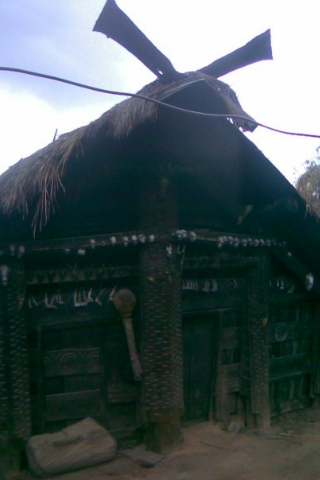
As Tangkhuls are basically an agrarian society, wealth in olden days was computed in terms of food grains and livestock of the family. So a rich man is someone who has a surplus of food grain and cattle. Life was that simple. Erection of totems and stones was a luxury that only the rich could afford to do. The process involved feasting for weeks and even months of the whole village at the expense to the man who erects these symbols of prosperity. Many erected stones stand even today to remind the younger generations of the glorious past. However, there are only few moss covered wooden totems (poles) left even in interior villages, which would soon rot away erasing remnants of the past that was so different.

Erection of totems as I was told is done only by people who are rich and mainly by the eldest in the family or the clan. When it is decided that a family is going to erect totems, the news is made known to all the relatives, the whole village and subsequently the neighboring villages too. Preparation for the occasion include, searching for a witch doctor/priest, collecting spotless sacrificial animals(biggest to the smallest), bulk brewing of wine and beer (for the villagers and guests), bulk grinding of rice and other food grains, etc. Once these initial preparations are done, village elders along with the witch doctors go scouting to find the right trees and stones to be brought home for erection.

Trees and stone selection as I was told was not done randomly. Necessary sacrifices were offered and are felled based on what the tree or stone spirits reveal in dreams or through a medium. Only unmarried trees and stones are to be selected and felled. This is one part where I choose not to hide my sarcasm, unable to comprehend how trees and stones can possibly speak or could have spirits in them. Anyway, there are too many things that I don’t understand and may never understand about the past.

After the sex of the tree or stone is determined, the objects as I was told are adorned with the appropriate costumes of male or a female. Cross dressing entails serious curse upon the family which was believed to last for generations.
After felling the trees, the young men in the village are tasked to carry home the trees and stones in single pieces. The drinking and eating celebration starts with coming home of the first tree or stone and ends when all the totems are erected following strict sacrificial procedures.

Animals that are considered perfect in every aspect are sacrificed throughout the erection ceremony. There are folk tales that suggests even human beings were sacrificed at the time of totem erections. However, my grandfather didn’t mention about this particular thing. Maybe he didn’t want me to know that people then were inhuman, or maybe human sacrifice was discontinued at some point of time. It was strictly mandatory to sacrifice animals and fowls from the smallest to the biggest. Missing out a single animal was believed to be a bad omen which has an associated curse, which would run in the family for generations. Scary as it sounds this one seems to be true as there are families where some of the siblings have some abnormality that people believe is the curse inherited from totem erection blunders.

This is one of the practices that were still prevalent till the late 19th century. With the advent of Christianity, the practice became odd and conflicting with the new faith. There is nothing I can connect this practice with the Tangkhuls of today. The time gap and difference between the present and the semi distant past is too wide. It is more like the past Tangkhuls disappeared one fine day like the Incas and Mayans and the present Tangkhuls suddenly replaced them. I am a Tangkhul, one of the many who are struggling to connect with the past.


Note this is a draft version that Google allowed me to post; If there are any grammatical mistakes or Typos, shoot a mail to Eric Schmidt and Google